























4 Best Batteries for Energy Storage in 2026
2026.06.10


The global battery energy storage system (BESS) industry is entering a new phase of rapid growth. According to industry forecasts, the market is expected to increase from USD 50.81 billion in 2025 to USD 105.96 billion by 2030, with a compound annual growth rate (CAGR) of 15.8%. The fast expansion of renewable energy generation and the modernization of power grids are two major forces driving this momentum.
Meanwhile, large-capacity systems are becoming the mainstream direction of the industry. Utility-scale projects increasingly favor storage systems above 10 MWh for applications such as renewable integration, peak shaving, and long-duration energy storage. In China alone, more than 80% of BESS bidding projects in 2023 exceeded 100 MWh.
As projects continue to scale up, expectations for batteries for energy storage are also rising. Leading manufacturers are now competing to launch higher-capacity lithium-ion batteries for energy storage and more integrated containerized systems. This article highlights four leading lithium-ion batteries worth your attention.
4 Best Lithium Batteries for Energy Storage Solutions in 2026
1. EVE 628Ah Cell + 5MWh System (MB56 “Mr. Big” + S556H201 “Mr. Giant”)
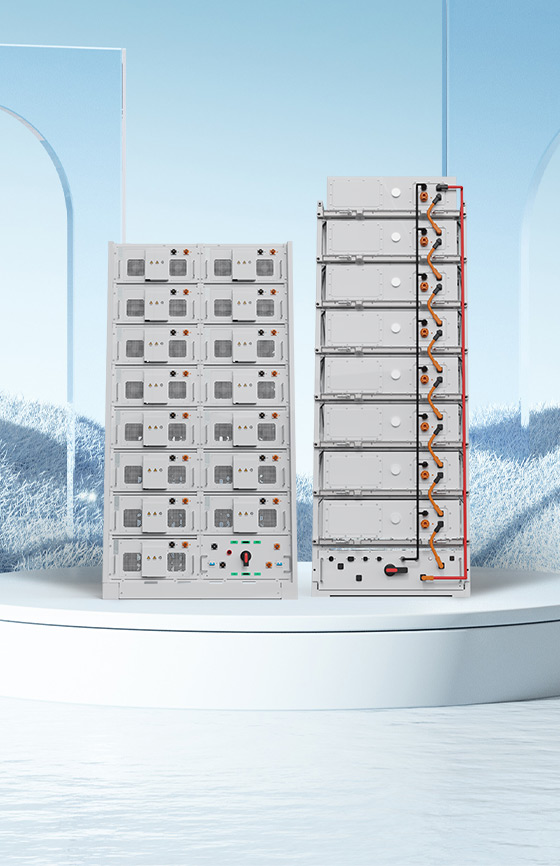
EVE Energy has established itself as a Tier-1 manufacturer with its Mr.Big (MB56) 628 Ah cell and the integrated Mr.Giant 5 MWh system. This combination represents one of the most field-proven large-format solutions available today.
Cell Specifications: EVE MB56 (Mr.Big)

Parameter | Value |
Nominal Voltage | 3.2 V |
Nominal Capacity | 628 Ah |
Nominal Energy | ~2,009 Wh |
Dimensions (H × L × W) | 206.7 × 352.2 × 71.7 mm |
Weight | 11,500 g ± 300 g |
Initial Internal Resistance | ≤ 0.25 mΩ |
Charge/Discharge Rate | Standard 0.5P / 0.5P |
Nominal Cycle Life | ≥ 8,000 cycles (to 70% SOH, 25°C, 0.5P) |
Charging Temperature | 0°C ~ 60°C |
Discharging Temperature | −30°C ~ 60°C |
System Specifications: EVE S556H201 (Mr.Giant)

Parameter | Value |
Nominal System Capacity | 5,015 kWh (5 MWh) |
Battery Cell | MB56 (628 Ah) |
System Configuration | 1P416S × 6 |
System Voltage Range | 1,164.8 V – 1,497.6 V |
Charge/Discharge Rate | 0.5C / 0.5C |
Container Size | 2,438 × 6,058 × 2,896 mm (20-foot) |
System Weight | ~45 tons |
Communication | CAN |
Why EVE’s 628Ah Cell and 5MWh System Stand Out in 2026
l Early mass production and utility-scale validation
EVE was among the first manufacturers to commercialize a 600Ah+ battery cell platform at scale. Its 628Ah MB56 cell has already been deployed in large utility-scale ESS projects, including a 400MWh independent energy storage station.
l High real-world capacity and efficiency
Although officially rated at 628Ah, the cell typically delivers around 670–680Ah in real testing due to its capacity redundancy design. Combined with advanced stacking technology and optimized current collection, the platform achieves up to 96.2% efficiency.
l Simplified system architecture
The Mr. Giant 5MWh system reduces the number of battery packs, cables, BMS units, and maintenance points by up to 50%, helping lower lifecycle O&M costs by approximately 30%.
l Advanced safety and global compliance
The system integrates multi-level fire protection, intelligent fault isolation, and NTP thermal protection technologies, while also meeting international market requirements for large-scale ESS deployment.
l Mr. Giant Pro’s “5-year zero degradation” advantage
The upgraded version introduces targeted SEI repair technology that significantly reduces degradation during the first five years of operation, improving lifecycle energy throughput and project economics.
2. EVE 105Ah Cell (LF105)
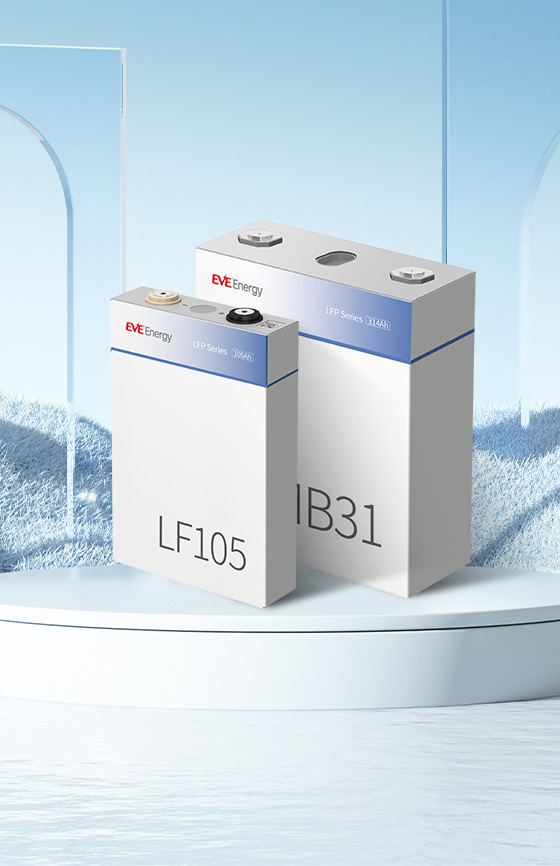
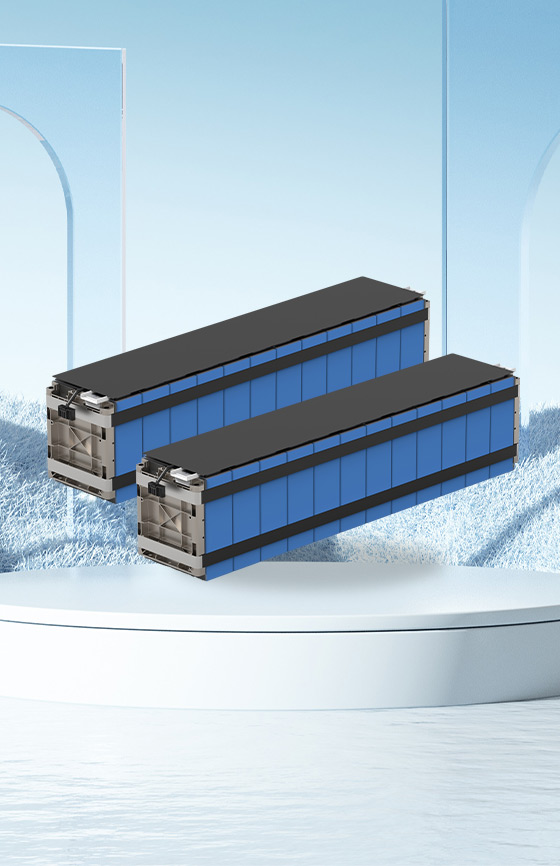
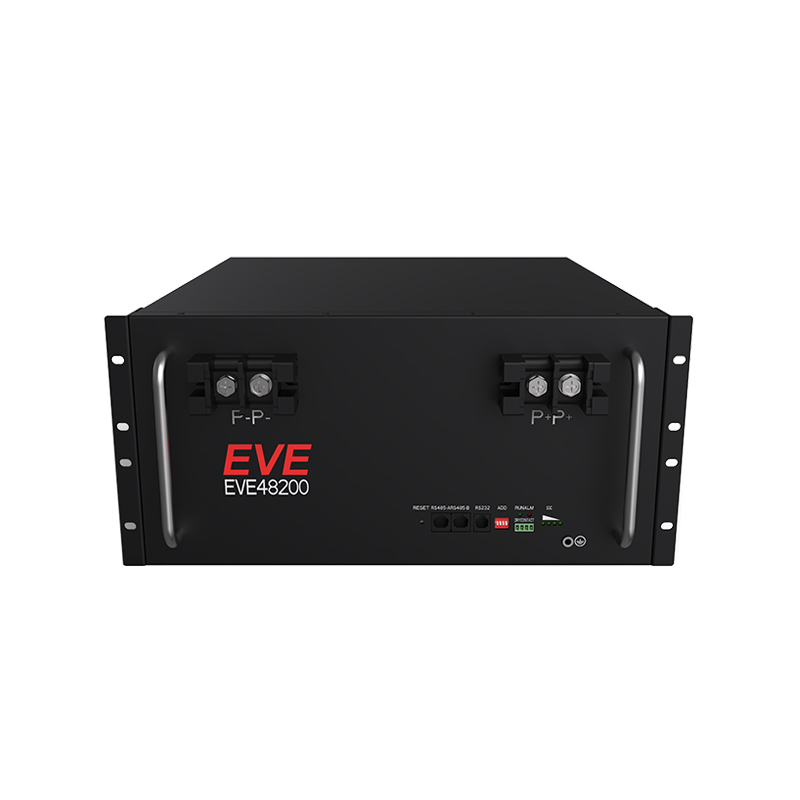
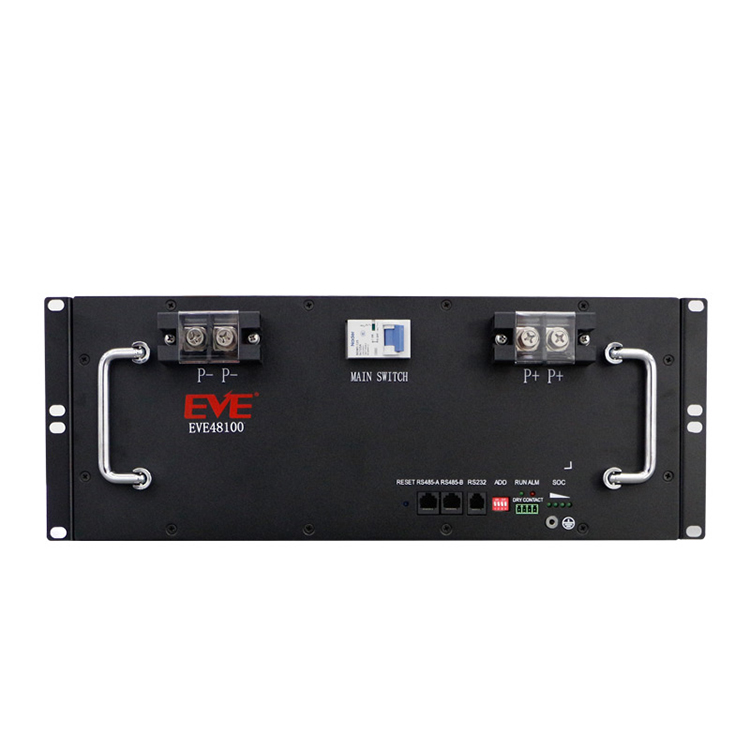
For applications requiring modular flexibility rather than utility-scale containers, the EVE LF105 remains an outstanding lithium battery for energy storage in commercial, residential, and specialty vehicle markets.

EVE LF105 Cell Specifications
Parameter | Value |
Nominal Voltage | 3.2 V |
Nominal Capacity | 105 Ah |
Nominal Energy | 336 Wh |
Dimensions (W × T × H) | 130.3 × 36.3 × 200.5 mm |
Weight | 1,980 g ± 60 g |
Initial Internal Resistance | 0.32 mΩ ± 0.05 mΩ |
Charge/Discharge Rate | 0.5C / 0.5C |
Nominal Cycle Life | ≥ 4,000 cycles (to 80% DOD, 25°C) |
Charging Temperature | −10°C ~ 60°C |
Discharging Temperature | −35°C ~ 65°C |
Application Scenarios | Residential, C&I and utility energy storage systems, telecom backup and UPS, EV conversion packs, engineering machinery, forklifts and golf carts, vehicle power supply, marine and RV/off-grid systems. |
Why EVE LF105 Stands Out in 2026
l Higher capacity within the same footprint
Compared with earlier 100Ah platforms, LF105 increases capacity by around 5% without changing the physical size, improving overall energy density.
l Longer cycle life for high-frequency applications
Advanced cathode coating and electrolyte technologies help extend cycle life beyond 4000 cycles, making it suitable for demanding daily cycling applications.
l Excellent thermal and low-temperature performance
The optimized housing design improves heat dissipation, while the cell can still maintain strong capacity retention under low-temperature conditions.
l Low internal resistance and strong reliability
Its low impedance design supports stable power delivery and high efficiency, especially in telecom backup, UPS, RV, and marine applications.
l Ideal for distributed ESS markets
The LF105 balances safety, energy density, and compact design, making it attractive for modular and commercial energy storage systems.
3. CATL 587 Ah Cell & TENER 6.25 MWh System
CATL is another top BESS battery manufacturer worldwide. Its TENER platform, built around the 587 Ah cell, sets the benchmark for long-duration storage with unprecedented degradation control.

CATL 587 Ah Cell Specifications
Parameter | Value |
Nominal Capacity | 587 Ah |
Nominal Energy | ~1.878 kWh |
Volumetric Energy Density | 430–434 Wh/L |
Cycle Life | 10,000+ cycles |
Round-Trip Efficiency | 96.5% |
CATL TENER 6.25 MWh System Specifications
Parameter | Value |
Total Capacity | 6.25 MWh |
Container Size | 20-ft standard |
Weight | ≈45 tons |
Standard System Voltage | 1331.2 V |
Communication | CAN / RS485, LAN (IEC 61850), Dry Contact |
Degradation | 5 years zero degradation (power & capacity) |
Why CATL’s 587Ah Cell and TENER System Stand Out in 2026
l Positioned as a next-generation industry standard
CATL designed the 587Ah platform to become a highly manufacturable and widely compatible large-format storage standard for utility-scale projects.
l “5-year zero degradation” technology
The TENER platform became one of the industry’s most discussed ESS solutions by significantly reducing capacity and power degradation during the first five years.
l High energy density and compact footprint
With energy density reaching over 430Wh/L, the 6.25MWh system improves land-use efficiency and reduces installation footprint for large-scale renewable projects.
l Advanced safety architecture
The platform combines thermal-resistant separators, safety electrolytes, and an anti-propagation design to improve thermal stability and reduce operational risks.
l Reduced integration complexity and lower system cost
The system architecture lowers module count and component quantity, helping reduce integration costs and improve long-term project IRR.
4. CALB 588 Ah Cell & 6.25 MWh System
CALB’s “Ultralife” series 588 Ah cell and its 6.25 MWh container system represent the company’s third-generation long-life energy storage technology, with a distinct focus on manufacturing maturity and rapid commercialization.
CALB 588 Ah Cell Specifications
Parameter | Value |
Nominal Capacity | 588 Ah |
Volumetric Energy Density | 450 Wh/L |
Cycle Life | 10,000+ cycles (to 70% SOH) |
Degradation | 3 years zero degradation |
Manufacturing Process | Mature winding process |
CALB 6.25 MWh System Specifications
Parameter | Value |
Total Capacity | 6.25 MWh |
Container Size | 20-ft standard |
Component Reduction | 30% fewer parts |
Failure Rate Reduction | 20% |
LCOS Reduction | 5% – 8% |
Certifications | GB, IEC, UL |
Why CALB’s 588Ah Cell and 6.25MWh System Stand Out in 2026
l High energy density with mature manufacturing technology
CALB combines 450Wh/L energy density with a mature winding process, offering a balance between performance, manufacturability, and cost control.
l “3-year zero degradation” capability
The platform uses lithium replenishment and SEI self-repair technologies to minimize early-stage degradation and improve long-term energy throughput.
l Ultra-long cycle life
With over 10,000 cycles at 70% SOH, the system is designed for long-duration renewable energy projects with extended operational lifespans.
l Zero thermal propagation safety design
Its thermo-electric separation and dual-insulation ceramic composite materials resistant to temperatures above 1000°C improve thermal isolation and reduce the risk of thermal runaway propagation.
l Lower LCOS and better project economics
By reducing component count and failure rates, the 6.25MWh system helps lower lifecycle storage cost and improve economic returns for utility-scale projects.
Large-Capacity Energy Storage Cell Comparison:
| Comparison Item | EVE 628Ah (MB56 / "Mr.Big") | CATL 587Ah | CALB 588Ah ("Ultralife" Series) |
| Nominal Capacity | 628Ah | 587Ah | 588Ah |
| Cell Energy | 2009Wh (≈2.0kWh) | ≈1.878kWh | ≈1.882kWh |
| Volumetric Energy Density | >430Wh/L | 434Wh/L | Up to 450Wh/L |
| Cycle Life | >8,000 cycles | >10,000 cycles | >10,000 cycles |
| Manufacturing Process | 4th-generation high-speed stacking technology, 5% higher space utilization | High-compaction coating and dense cell arrangement design | Mature winding process with high production efficiency and stable cost |
| Core Technologies | Innovative current collector technology creating an "electron highway," achieving 96.2% efficiency | Biomimetic SEI, self-assembled electrolyte, and impedance growth suppression technologies | Thermal-electrical separation design and dual-insulation ceramic composite materials resistant to temperatures above 1000°C |
| Safety Design | 14μm reinforced composite separator and NTP (No Thermal Propagation) technology | Three-dimensional protection system with PPB-level cell defect rate control | Directional pressure relief structure enabling zero thermal propagation |
| Key Strengths | Highest capacity and cell energy, simplified system architecture | Long cycle life and strong anti-degradation capability | High energy density and strong cost competitiveness |
| Typical Applications | Utility-scale energy storage, renewable energy integration, grid stabilization and frequency regulation, peak shaving, solar-plus-storage projects, and commercial & industrial (C&I) energy storage systems. | ||
Energy Storage System (ESS) Comparison:
| Comparison Item | EVE 5MWh (S556H201 / "Mr.Giant") | CATL 6.25MWh (TENER) | CALB 6.25MWh ("Ultralife" Standard Cabinet) |
| Rated System Capacity | 5MWh (5,015kWh) | 6.25MWh | 6.25MWh |
| Container Format | Standard 20-ft container | Standard 20-ft container | Standard 20-ft container |
| System Weight | Approximately 45 tons | ||
| Internal Architecture | 1P416S × 6 (or 6P416S), supports 0.5C charge/discharge rate | Four-column architecture compatible with mainstream 1500V PCS platforms | Modular long-duration energy storage platform |
| System Efficiency | Up to 95% | Not disclosed | Not disclosed |
| Cost Reduction Benefits | 50% fewer maintenance and vulnerable parts, reducing lifecycle O&M labor costs by 30% | 33% fewer battery modules and 40% fewer components, reducing system integration cost by 15% | 30% fewer components and 20% lower failure rate, reducing LCOS by approximately 5.8% |
| Space Utilization | High space efficiency and supports four-unit parallel deployment | 30% higher energy density per unit area and 20% smaller plant footprint | Highly integrated design to match 20-year PV project lifetimes |
| Market Positioning | High-efficiency, simplified, and safe ESS for diverse energy storage applications | Next-generation grid-scale storage standard emphasizing manufacturability and compatibility | Cost-optimized solution for large-scale renewable energy plants, grid services, and C&I projects |
| Key Competitive Advantage | High system efficiency and lower O&M costs | Large system capacity and excellent land-use efficiency | Lower LCOS and strong project economics |
| Typical Applications | Utility-scale energy storage, renewable energy integration, grid stabilization and frequency regulation, peak shaving, solar-plus-storage projects, and commercial & industrial (C&I) energy storage systems. | ||
Note: The above data is based on publicly available product specifications and news reports. Information may be updated over time, and the data is for reference and educational purposes only.
How to Choose the Right Battery Cell and System
Selecting optimal lithium-ion batteries for energy storage requires evaluating multiple interdependent factors. Here is a practical framework for procurement decisions.
1. Start with the Application
Grid-scale storage (frequency regulation, renewable smoothing, peak shaving) prioritizes low LCOS and high cycling capability. Commercial storage (demand charge reduction, solar self-consumption) values compact footprints and modular expansion. Long-duration backup (6–8+ hours) emphasizes low- rate performance and calendar life over power density.
2. Compare Cell and System Capacities Together
A larger cell does not always yield a better system. Blindly increasing cell dimensions can elevate internal resistance, create current distribution non-uniformities, and raise thermal runaway risks due to extended venting paths.
The superior approach matches cell design with system architecture—EVE’s through-type large pack and CATL’s four-column design reduce interconnects by 30–50%, offsetting the challenges of large-format cells.
3. Examine Cycle Life and Degradation Performance
For 15–20 year projects, LFP chemistry dominates due to its 3,000–6,000+ cycle baseline (advanced products reach 10,000–15,000 cycles). Top manufacturers now publish real-world degradation data. EVE’s and CATL’s “5-year zero degradation” claim provides the strongest long-term evidence. CALB’s 3-year zero decay and SEI self-repair mechanisms also reduce lifetime replacement risk.

4. Verify Safety Features
LFP cathodes offer inherent thermal stability, making them intrinsically safer than NMC. At the system level, demand:
l Multi-level liquid cooling thermal management (cell temperature differential <3°C)
l AI-based BMS predictive monitoring
l Pack-to-cluster-to-PCS multi-stage short-circuit protection
l Triple-fuse mechanisms
l Compliance with NFPA 855, UL 9540A, and GB/T 42288
For example, EVE’s Mr.Giant includes 24-hour fire monitoring and three-level intelligent control circuit breaking.
5. Evaluate Footprint and Energy Density
For land-constrained sites, container-level energy density drives significant capital savings. CATL’s TENER achieves 430 Wh/L at the cell level, enabling 6.25 MWh in a 20-ft container—a 25% improvement over prior systems. EVE’s 5 MWh system reduces land costs through 4-box parallel configurations. Higher density directly reduces civil works and land lease expenses.
6. Consider Integration and Scalability
Modular “plug-and-play” designs shorten deployment timelines. Large-format cells inherently reduce data acquisition points, BMS channels, and cable harnesses, cutting upfront integration work. For future expansion, verify that the supplier’s architecture supports straightforward capacity additions without replacing existing units.
7. Assess Manufacturer Strength and Supply Chain Reliability
Large storage projects fail when suppliers cannot deliver. Prioritize manufacturers with:
l Automated, high-volume production lines
l Global certifications (like IEC 62133, UL and GB/T 36276-2023)
l GWh-scale reference installations with zero major incidents
l Transparent traceability from raw materials to finished cells
Avoid “B-grade” or “C-grade” cells from secondary channels—these exhibit rapid fade, high impedance, and unpredictable safety behavior.
8. Balance Upfront Cost with Long-Term Value
While LFP upfront costs now range $80–100/kWh, the lowest initial price rarely minimizes 20-year LCOS. A comprehensive LCOS model must capture:
l Capital expenditure (CAPEX)
l Operating expenses (OPEX), including scheduled maintenance and unexpected repairs
l Round-trip efficiency losses (a 1% efficiency gap compounds significantly over time)
l Capacity fade and end-of-life replacement costs
Investing in high-efficiency liquid cooling, superior cycle life, and proven low degradation can raise initial equipment costs but can improve project IRR by several percentage points over the asset’s full lifetime.
Conclusion
The four products covered in this article — the EVE LF105, EVE MB56 / Mr. Giant 5 MWh system, CATL 587 Ah / TENER 6.25 MWh, and CALB 588 Ah / Ultralife 6.25 MWh — collectively define the leading edge of lithium-ion batteries for energy storage in 2026.
From modular commercial deployments to gigawatt-scale grid infrastructure, the right choice begins with understanding application priorities, then matching cell chemistry, system architecture, cycle life, and lifecycle economics to the project's specific demands.
EVE Energy stands as a global top-tier ESS player, ranking No.2 in global energy storage battery shipments with 71 GWh in 2025 and leading large-format LFP cell mass production worldwide. If you are interested in EVE Energy’s solutions, feel free to contact us for more!
Relevant information:
1. https://www.evlithiumcharger.com/News/eve-energy-5mwh-ess-replus-2025.html
2. https://www.catl.com/uploads/1/file/public/202604/20260409212143_f2npbuioci.pdf
3. https://www.ess-news.com/2026/04/29/587-ah-vs-588-ah-the-difference-is-more-than-1-ah/
4. https://www.ess-news.com/2025/04/16/catl-unveils-587-ah-battery-energy-storage-cell/
6. https://www.evlithiumcharger.com/News/catl-unveils-587ah-lifepo4-ess-cell.html
7. https://www.catl.com/en/news/6232.html
9. https://www.evlithium.com/lifepo4-battery-news/calb-new-storage-cells-systems.html
10. https://eu.36kr.com/en/p/3330710107286024
11. https://bessmanufacturers.com/resources/eve-energy-2025-annual-results-energy-storage/